
Students can't write?
THE SOLUTION
A Shared Framework for Coherent Instruction
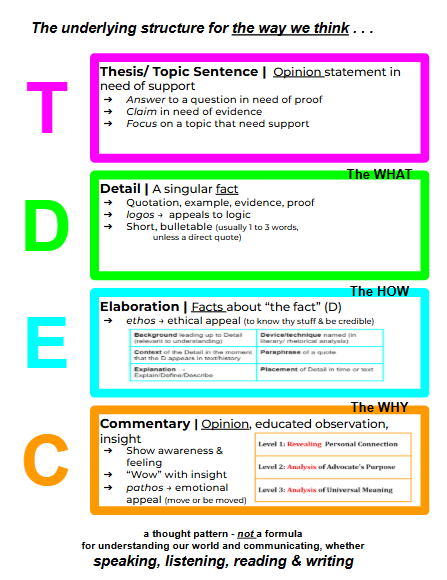
TDEC isn't just a paragraph structure, it's a shared academic language that creates vertical alignment K-12 and enables cross-curricular application.
This replicable instructional architecture transforms how teachers teach and how students think, creating consistent expectations across every classroom in your district.
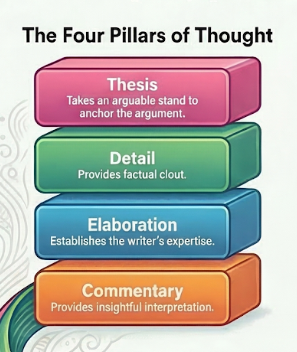
Thesis
Clear, arguable statement that guides all subsequent thinking
Detail
Evidence and specific examples that support the thesis
Elaboration
Explanation connecting evidence to the thesis
TDEC Teaching Resources
The TDEC acronym points us to common academic vocabulary that gives us the power to talk about writing in terms that our students can embrace to immediately help them shift into successful writing. More importantly, continued use over time leads to an expanding understanding of the TDEC thought elements, growing with students over the course of years in both depth and sophistication. Learning to write in this way empowers students to improve their writing in authentic ways. Real, observable growth leads to growing confidence in writing and thinking – keys to personal confidence.
That being said, TDEC is just the beginning of a larger program called Finite Writing, which offers a host of strategies and philosophical approach to teaching writing that, taken together, create fertile grounds for critical change in students’ writing. In other words, TDEC is important while the Finite Writing framework is invaluable to the larger process of working with students on their writing skills.
To learn more about where TDEC came from, read the TDEC Origin Story.
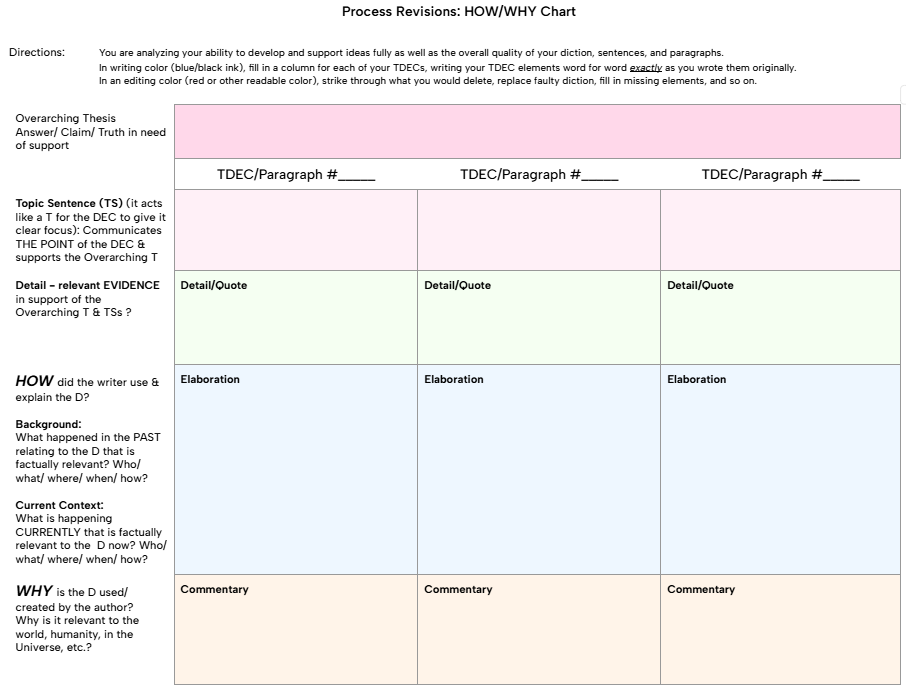
Process Revisions is a deep revisions process that requires students to deconstruct their writing, rethink how they thought and wrote that thinking, and then revise their writing. This chart is a key piece in students deconstructing their writing so that they can reconstruct – and resee – their writing.
Go to the How/Why Chart
FREE resource
For use with the Process Revisions Protocol How/Why Chart for Revisions
Writing rubrics should be about more than grading. They should offer highly relevant feedback as they offer a clear pathway to the “target.” It follows then that, if we accept these things as being true, rubrics should be used consistently throughout the year because changing the rubric for each assignment is like moving the target.
This set of rubrics offers a rubric for each of the TDEC thought elements separately as well as a DEC Construction rubric.
Go to the Set 1 Rubrics > FREE resource
Unfamiliar with TDEC? Learn more with the TDEC Starter Kit.Writing Rubric: Learning Pathway 2.0 TDEC Element Rubrics - Set 1
For young and struggling writers, learning to write is exponentially challenging. We need to give them a starting point – a place to prompt their thinking to draw out what must be in their writing – a place to “hang” their ideas, so to speak. Prewriting charts are essential as a scaffold for learning the essential thought elements that must be in a good piece of writing.
This set of prewriting charts offers two different versions of prewriting charts. Both offer scaffolding questions to prompt student thinking. The first – for one TDEC – is as simple as it gets. The other three offer writing a piece of text with either one, two, or three DECs.
Go to the Prewriting Charts Set 1 > FREE resource
Unfamiliar with TDEC? Learn more with the TDEC Starter Kit.TDEC Prewriting Charts - Set 1
TDEC poster
This poster is offered here in PDF format so that you may print it to poster size for your students to easily reference in the classroom.
Go to the TDEC Poster >
FREE resource
Unfamiliar with TDEC? Learn more with the TDEC Starter Kit.TDEC Starter Kit
This poster is offered here in PDF format so that you may print it to poster size for your students to easily reference in the classroom.
Go to the TDEC Starter Kit >
FREE resource
The Finite Writing Book
A definitive blueprint for implementing the TDEC instructional framework in any classroom or learning environment. Packed with actionable lesson plans, real-world work samples, rubrics, and practical strategies built on 25+ years of teaching expertise.
- ★ Approaches to teaching writing with the "TDEC" acronym and the Finite Writing Program
- ★ Annotated student work samples
- ★ Ready-to-use graphic organizers & rubrics
District Alignment
Adopted by school districts to establish a shared academic language and seamless K–12 continuity in vertical learning.
Proven Pedagogy
Authored by veteran educator, instructional coach, and professional learning leader Tara Banton, M.Ed.
Rapid Student Growth
Delivers noticeable clarity, critical thinking, and noticeable growth in writing within 12 weeks when taught with fidelity.
Testimonials
About TDEC & Finite Writing methods:
Student: “Here at Cornell every freshman is required to take a version of a class called the First Year Writing Seminar to develop their writing abilities. The seminars offered through the English department are known for being especially rigorous, so I enrolled in one because I was worried that my writing was not up to the collegiate level. Last weekend I had to write my first essay for my seminar, a two page research-based piece. After doing the initial research, the writing itself actually only took about 50 minutes (a product of all of the timed writings at [high school], I'm sure) and I found that I had subconsciously TDECed the entire paper (despite swearing to myself that TDEC wouldn't follow me to college). I didn't think it was my best work, but I had tests to study for so I submitted it and moved on to other things. When I walked into my lecture on Monday, my paper was projected on the screen. The professor proceeded to have the class analyze it as an "example of an exceptional essay," praising mostly my organization and clarity but also touching on the quote weaving (thanks, TDEC!). I realized after rereading the paper that all of the small things that we learned in AP English (creating a good thesis, quote weaving, organization, and yes, even TDECs) had become a subconscious part of my writing process that really made my writing infinitely better as a whole. I had never realized how much your AP English course taught me until I actually began to think about the roots of the methodologies that I use when I write. Anyway, after class the professor called me aside and told me to thank whoever taught me how to write, so that's exactly what I'm doing. Thank you for preparing me so well for this level of writing (even though I didn't even know you had done it). I know that this foundation in writing will open countless doors for me throughout and after college.”
Parent: “I thought that you would be interested to know that he took only one non-film class in his very busy first semester, and that class was College Writing. His teacher was so impressed with his work that, during an end-of-semester interview, she asked him directly where he had learned to write so well.”
Teacher: “Ms. Banton writes and teaches writing in a structure that combines technicality with creativity. Through the analysis of many excellent writers, she discovered the elements of information that make writing good and the organization that makes it clear. She then teaches others how to teach writing well. It is a trustworthy method of teaching writing because she has data to prove that her students improved significantly as she introduced this system of teaching. My own experience using her methods have been extremely successful. I taught writing for years using various popular methods, but I did not feel successful and did not see measurable growth. Over the last 3 years, I have used the TDEC method, and my students’ improvements are obvious, measurable and sustainable. I feel like a successful writing teacher now.”
Former students talking about Process Revisions:
“The process revisions were extremely valuable to me. I found that it was the quickest way for me to focus on what my flaws were and improve them promptly. The methodical nature of the whole process [the full Process Revision exercise] was a very helpful and streamlined procedure. It also forced me to be extra thorough, which enriched my writing after a while. By laying out all the parts of an essay into a clean and organized chart, I was able to physically see where my writing was sparse and lacking. When I compare essays from the beginning of the year to essays at the end of the year, the improvement is truly remarkable.”
“My paragraphs were [finally] set with appropriate, descriptive topic sentences and clearly followed the DEC chunk. When I was able to master this, I enabled myself to introduce new, creative ideas in a clear manner. My writing overall has greatly improved, and I know it's because of the repeated revision, which I didn't always enjoy but benefitted from immensely, and thank you, Ms. Banton, for making us do it.”
“I did not spend the year looking at well-marked essays from previous years of AP English 4 tests; I spent the year looking at rubbish essays of my own, finding out what made them initially rubbish, and identifying how I can circumvent such aspects of my writing under pressure.”
Commentary
Analysis that demonstrates deeper understanding